Dush
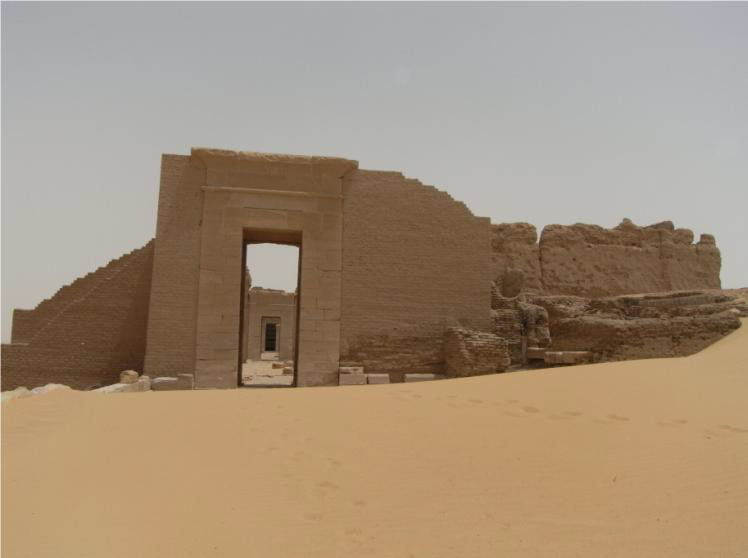
Dush, known in Graeco-Roman times as Kysis, was an ancient border town that held a garrisoned fortress to protect the community and the south-western frontier of the Roman Empire. It is situated about 15 kilometres north-east of el-Qasr and is located on a strategic hill along an important caravan route (the southern end of Darb al-Arbain). Soldiers were sent here from the Nile Valley from probably as early as the Old Kingdom to protect the Egyptian border. The remains of the fortress visible today, however, date to the Roman period. The fortress stands atop the highest hill in the area about 2 kilometres (1.2 miles) northeast of the modern village of Dush. The fortress is the oldest building found so far on the site, dating back to the Ptolemaic era. The ruined walls, rising to 6 meters (19.2 feet) enclose a rectangular space. During the Roman period Kysis was also an important religious center and pilgrims came from all over the Empire to visit the temple of Isis, Serapis and Osiris. The remains of this limestone temple stand just outside the fortress walls. It was built in the reign of Domitian (between AD 81 and 96) on an earlier mudbrick shrine and the emperors Trajan and Hadrian added modified the temple with new architectural elements and decorations. The temple is mentioned on the Trajan Column in Rome. Although there are few decorations, parts of the temple are believed to have been covered in gold. On the first pylon of the temple is an inscription identifying the town as Kysis. A mudbrick temple is located about 200 m west of the main one. The date of this still remains uncertain, but it is probably also Roman. The Roman town connected to the fortress was laid out on either side of a main thoroughfare running south from the main temple. Several large houses built in the first century AD have been found here. They had courts and peristyles and were decorated with frescoes. The inhabitants of the place were buried in domed tombs in cemeteries located to the north and west of the town. Kysis was a bustling community with merchants, potters, jewellers, metal-workers and other craftsmen. Farmers provided produce and meat for the area, and some of it, especially the grain, was exported to other communities in the oasis, the Nile Valley, and perhaps to Rome itself. The settlement was probably abandoned in the 5th century. Among the most notable finds from the Roman fortress is the Treasure of Dushdiscovered in 1989 by the French team excavating the site. It consists of a collection of religious objects and jewellery from the 4th-5th centuries. It included a golden crown with a figure of Serapis as well as bracelets and pendants of gold and semi-precious stones. The treasures are today on display in the Egyptian Museum in Cairo. Other finds include large amounts of ostraca and papyri from the 3rd-5th centuries (CISS Inventory 2010; Vivian 1990).
Site coordinates: N 24 34 505 E 30 43 030
Price (years 2019-2020): 40 EGP (foreigner), 20 EGP (foreigner student), 10 EGP (Egyptian), 5 EGP (Egyptian student).