Ain al-Tarakwa
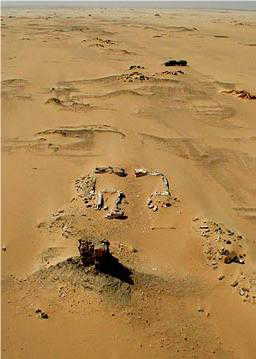
Ain al-Tarakwa is located on the road to Umm al-Dabadib which
led to the Darb Ain Amur. The site was completely unknown until 1949 when it
was revealed by a sandstorm. The site has not been excavated so it remains
fairly unknown, but the pottery on the site dates to the late Roman period (3rd
and 4th centuries). On the site is a sandstone temple with a tripartite
sanctuary and a large cella. The temple is unexcavated, but decorations
indicate it is dedicated to Amun-Re. The temple is surrounded by a mudbrick enclosure
wall. Unfortunately, the northern wall was destroyed by a front loader in
recent times, when some blocks from the temple were also removed. Within the
enclosure wall are the remains of a mudbrick church. In addition to the temple,
there are traces of mudbrick walls, vaults and lintels visible in the sand both
within and without the enclosure. There is also a large cemetery located to the
south, with vaulted mudbrick tombs, most of which have collapsed. They contain
burials from both the Roman and the Coptic periods. In the same area are two
large wells (CISS Inventory 2010; Vivian 1990).